
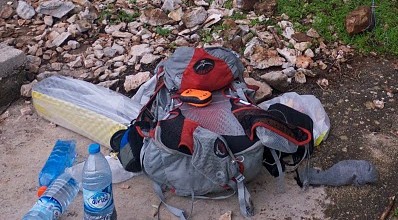
 I thought it might be quite interesting to show you what I actually had in my pack on my February trip on the Lycian Way, and to look back at which of it made sense and which less so. I was not travelling ultralight, and I’ll simply claim that I once again packed far too much.
The packing list itself is on Google Docs and can be viewed by anyone. Here I will try to explain a little about the individual items of gear.
Sleeping
 I had surprisingly good weather and only rarely got frost at night, despite travelling in early March. Here I would definitely do without the 2nd sleeping mat and also take a thinner sleeping bag.
On my last trip in the Harz I got rather chilly with the sleep setup I had actually planned, panicked at the last minute and decided at the very last second on the The North Face Cat’s Meow for more insulation. As a result I had almost 900 g more to lug around than I had actually intended.
Kitchen
 Everything really worked here. The Caldera Ti-Tri with the alcohol setup also worked well with fuel paste. Next time I might take the complete set in order to be able to use firewood as fuel too. That also works very well on this trail, and wood can be found practically everywhere.
For the water filter you could certainly also take a Steripen or a chemical solution such as Aquamira instead of a ceramic pump filter (-456 g) like the one I had with me. In future I will switch to Aquamira too. It is lighter and doesn’t bring extra beads of sweat to my forehead. Once it gets hotter, however, and you depend on the water from the wells and cisterns, it is definitely advisable to pre-filter.
Electronics
 Here I could have saved quite a lot and done things differently. The Panasonic LX3 (there is now an LX5), which I had borrowed, is very light and great for wide-angle shots, but I come from an Olympus E-510, and the image quality of the LX3 doesn’t even match that. I solved the power supply with 2 batteries and a charger. With 3 batteries I would probably have got through the whole holiday without recharging.
The Kindle 3G helped me pass the time and was not just a luxury item but also contained Kate Clow’s guidebook, which I had painstakingly scanned beforehand. I would not want to leave the Kindle at home again. A brilliant device that also survived the odd knock well. What is more, it only had to be charged once on the trip.
About the Spot I really can’t say anything that hasn’t already been said in one of our articles about it. For me it is simply as much a part of the kit as the first aid kit.
The iPhone is one of the heavier phones to take along, but it let me get in touch with my family by email, tweet occasionally and, above all, listen to a lot of music, which I did regularly. Some engines simply run better when oiled, and I walk better with music, which is why I was happy to carry the odd extra battery.
The Garmin Vista CX can of course be left out, and although I had it with me, I got lost several times. The maps for Turkey, whether digital or on paper, are rather modest. It was, however, used less for navigation and really only for recording tracks and marking waypoints. It ran for more than 3 days of hiking on one set of Energizer Ultimate Lithium, which is not bad. The additional device is considerably more energy-efficient than my iPhone, which would definitely need charging after a day of collecting GPS data. Incidentally, I also prefer to pack the Vista rather than the newer GPS devices, precisely because of its lower battery consumption.
 The Energizer Ultimate Lithium batteries are great and almost impossible to get in Turkey. Only in Antalya did I find some at a kiosk. The other batteries in Turkish shops are not cheap and have usually been sitting there for quite a while. I bought batteries locally that had already leaked in the packaging. With a bit of luck, Duracell batteries charge the iPhone by around 30 %, while the Energizers get to almost 70 %. If you want to stock up on batteries beforehand, take a look at eBay. I got mine there much more cheaply in a large pack.
The PortaPow charger, which I knew from the latest gear wrap-up by Lighthiker, proved itself well. In general, though, I have to say that recharging with batteries was a rather unsuccessful, heavy and certainly not environmentally friendly experiment. While the GPS device and the Spot were very economical, the iPhone could quickly eat me out of house and home. The biggest mistake was not packing a normal charger as well. So even in the hotel I was dependent on batteries. I didn’t think that through properly. A solar panel would have been much smarter, but I had expected far more clouds and rain and didn’t have enough money for a decent one.
As already mentioned, I would change my whole recharging strategy. I would not do without the iPhone but just limit its use. My camera situation has changed thanks to a new purchase, and on shorter trips I would not take the Kindle. I don’t want to do without the Spot, and if I want to keep uploading GPS data for my tours, I probably can’t get around the GPS device either.
Clothing
 As far as rain gear goes, I am very happy with the Marmot Super Mica. It hardly had to withstand any rain but was good wind protection when the Montane Slipstream was no longer enough for me. What I liked very much about the jacket was that the climate could be regulated well, so that, at least subjectively, I sweated considerably less than in my normal rainwear.
The rain trousers were a flop. Ever since my first trip I have been carrying the McKinley rain trousers around from time to time without ever having worn them in the rain. On this trail I wore them a few times in the evening after washing my hiking trousers. I don’t know how, but they broke, and I threw them away before the end of the trip. I would take rain trousers again but look for a different manufacturer or lighter alternatives.
I had 2 pairs of boxer shorts with me, which I intended to wear alternately. It ended with me wearing the Smartwool boxer shorts for almost the whole trail. The fit was ideal for me, and odour stayed well within limits too. Despite almost daily use, the boxer shorts stayed intact. After my return and roughly another 150 km, however, I now have a small hole. I would reckon with a lifespan of 500–600 km.
The Marmot Baffin Jacket proved itself as insulation, just as the gloves were not the worst decision when it got cold in the evening. The long johns, on the other hand, I didn’t wear once; they were more of an additional garment intended for cold nights in a thinner sleeping bag.
In addition to the cotton beanie it would have made sense to take a normal cap/Buff for sun protection. I did manage without one, though. Anyone travelling later in the year should definitely not go without, and next time I would pack one too.
About the shoes I have to say: my Hanwag boots are not light, and by now I prefer light trail runners for hiking. However, I would no longer have trusted my by now rather worn Columbias with this route, and buying a new pair of shoes shortly before the holiday was simply not possible any more. They performed very well on the fairly stony paths
Next time I would leave out the camp shoes (provided I have lighter hiking shoes by then, -338 g) and rely only on merino wool for underwear (+14 g). I will try to get the hat situation under control with a Buff. For the rain trousers I will look for a lighter alternative, or test a cuben fibre kilt such as the CloudKilt, which could incidentally replace the beak of the Echo I Shelter System.
Bathroom
 There is not that much to say here. The toothpaste was too much, which is why Denttabs might be worth considering, as they are easier to portion. Otherwise I could only save further here with a smaller towel and an adventurous toothbrush construction.
Miscellaneous
I had a travel phrasebook with me and no Turkish dictionary. If you want to communicate at least a little with the local people, it is best to pack a decent dictionary. A travel phrasebook like that, I think, only helps the hotel holidaymaker but is far too limited for conversations.
 I am thrilled time and again with my trekking poles. They are by no means among the lightest, but they have never let me down. By now they are more than 2 years old, easily have over 1,500 km under their belt and have always supported me reliably despite my weight.
 The backpack that carried everything is of course important too. Like my trekking poles, my Osprey Exos 46 is already getting on a bit. It is not yet 2 years old, but it too has been faithful to me for well over 1,000 km. As it was one of my lightest packs until recently, it was not only used for weekend and trekking tours but also taken along on short day hikes. I can’t complain about the carrying comfort, not even when it was carelessly overloaded with large amounts of water. By now, however, it shows some damage on the back, and I will contact Osprey about the warranty.
In future I will use a Mariposa Plus (-500 g) and buy a decent dictionary.
That is actually “already” everything I could think of off the top of my head. I am happy to take suggestions for improvement, criticism and mockery in the comments 😉