
 Which trekking boot is the best? Should you buy a trekking boot with a membrane, or rather a hiking boot without Gore-Tex and the like? A classic leather boot, or one made of Cordura, suede or nubuck? A heavy, stiff boot or a lighter hiking shoe? The choice is enormous and opinions differ widely. Here is my personal choice: the Hanwag Tatra…
Where and what is the trekking boot used for?
The boot should be comfortable to wear in warm and cool temperatures. There is no plan to use it in extreme weather conditions. To put it bluntly: neither for walking the dunes of the Sahara nor for crossing glaciers in Patagonia.
 It will, however, be used in winter for day walks in the Harz and in spring for multi-day hikes in warm Florida. It will be worn on trips with a light pack on mostly made-up paths, but also on multi-day tours in the Appalachians with a rucksack weighing up to 25 kg.
The trekking boot should not be too heavy
These requirements make it clear that the boot will be neither particularly stiff nor particularly light – a compromise is called for. Because of the different climates the boot is meant to be used in, it needs a pleasant climate inside and, at the same time, a decent degree of water resistance.
No good experiences with a Gore-Tex membrane
 With two pairs of boots that each had a Gore-Tex membrane I unfortunately did not have good long-term experiences. In one case the membrane leaked after a year, in the other after barely two years. Both times without any visible damage from the outside or to the lining. As both were a mix of Cordura and mesh fabric, there was no way of making the boots waterproof again by other means. In both pairs, in dry and warmer temperatures, far more moisture built up inside the boot than I would expect, with the unpleasant side effects that go with it…
That settled it for me: this time it was to be a sturdy but not too heavy leather boot without a membrane, but with a leather lining.
Trekking boots without a membrane, with a leather lining
Four boots made the short list: Meindl Borneo Pro, Lowa Terrano, Meindl Jersey Pro, Hanwag Tatra.
The be-all and end-all in this choice is of course the fit. In principle all of the boots fit my foot. Purely by feel, the Hanwag is a little narrow and the two Meindls a little too wide. The Lowa pinches around the toes – whether that will “break in” I cannot judge.
 In size 9 the boots weigh between 1530 g (Meindl Borneo) and 1750 g (Hanwag Tatra). Of these, the Hanwag makes the most stable impression around the ankle, the Meindl Jersey the least. That is why the Meindl Jersey drops off the short list at this point. I reject the Lowa because it does not give me such a good feeling and the pressure point around the toes strikes me as a problem. The soles are stiffest on the Meindl Borneo and the Hanwag Tatra, so the decision comes down to those two models. In the end I choose the Hanwag Tatra. The fit seems a little better for me, and on the Borneo I miss a rubber rand drawn a little further up over the toe.
What the Hanwag Tatra is
(from www.hanwag.com)
Light, very high-quality trekking boot with a modern look, available with a comfortable leather lining.
-
Lower-cut shaft with few seams
-
Particularly light yet stable construction on a Vibram® AW Integral sole
-
Plenty of sole flex for an easy, fatigue-free roll-through
Sizes: 6 -13
Weight: 760 g
Colours: ash, peat
Upper: waxed nubuck
Lining: leather
Sole: Vibram® AW Integral
Testing the Hanwag Tatra in practice
I have now worn the Hanwag Tatra for about 1000 km. Frequently on day walks in the Harz, but also on trekking trips in the Appalachians and in Florida.  The boot was treated right after purchase with Sno-Seal leather wax (see: care tips for leather hiking and trekking boots). So far my feet have always stayed dry. That said, I have not yet done any multi-day trips in the rain and on boggy ground. So I cannot say where the limits are for the waterproofness of waxed leather trekking boots.
The climate inside the boot in warm weather seems to me to be far better in any case than with boots that have a membrane. Despite a thorough coat of wax, breathability is still quite respectable.
The Hanwag Tatra is a compromise too – but a very good one
The stability of the boot and the sole is still fine in rough terrain with a heavy pack, although it reaches its limits there. On fast tours on made-up paths, on the other hand, the boot feels a little hard underfoot. I remedied that a little by swapping the spartan original insole for a Classic Unisex insole from Globetrotter. Postscript: I have since tried other insoles as well: Superfeet insoles for trekking and hiking boots reviewed
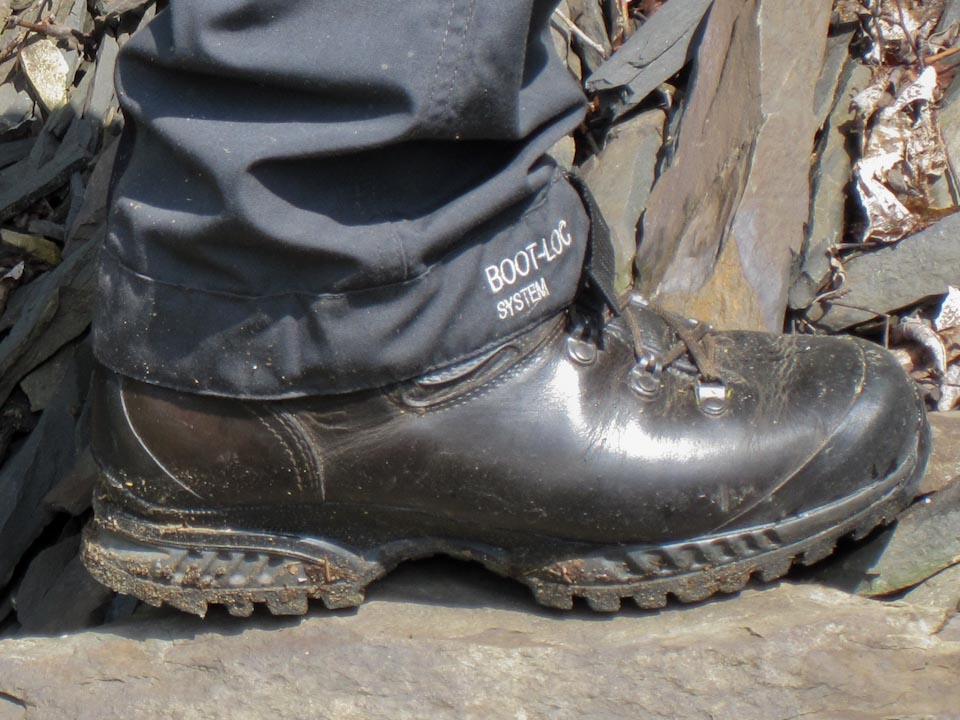 The grip of the sole is very good. Whether on scree or wet rock, the sole gives good contact with the ground and high slip resistance. It is also stiff and firm enough to walk on coarse gravel without anything “pressing through”.
Verdict on the Hanwag Tatra
In summary, for such a wide range of uses the boot is of course ONLY a compromise, as was to be expected. BUT it is a very good compromise.
If you do not want three or four pairs of hiking and trekking boots in the cupboard, the Hanwag Tatra will serve you well within the requirements described above. If it has to be more than that, there is probably no way around buying different models that suit each set of demands better.
I too still have a pair of lighter hiking shoes in the cupboard for short, fast, easy walks on firm paths.
**********************************************************
Check availability of the Hanwag Tatra at Globetrotter:
**********************************************************
Long-term experience with the Hanwag Tatra – postscript, January 2010
I am still very happy with the Tatra. So far there is no damage or excessive wear to be seen on the boots. There has by now been the occasional small ingress of water after long tours in the rain, but that really was in extreme conditions. Otherwise the Hanwag Tatra has also had to prove itself on snowshoe walks in the Harz . I can still recommend the boot absolutely.