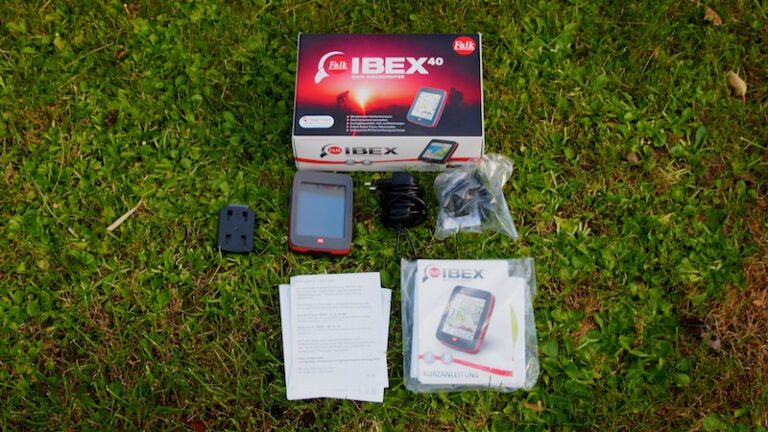

 The new outdoor units Garmin Oregon 450 and Garmin Oregon 450t are the direct successors to the popular Oregon 300 / 400t. In design, dimensions and weight the 450 series is largely identical to its predecessors. The proven touchscreen operation has been carried over as well. The differences in the hardware are in the detail…
Postscript 01/2013: the new models appear at the end of the first quarter of 2013 (see Garmin Oregon 600 / Garmin Oregon 650)
Testing the Oregon 450 in practice
At the time this review was published, the Garmin Oregon 450 / 450t had only been available in Germany for a few days. In that short time it was not possible to test every function thoroughly and in detail. Even so, the test should give a useful impression of the new Oregon 450 and Oregon 450t.
Case, handling and operation of the Oregon 450 and 450t
The case of the Oregon 450/450t is largely identical to that of the predecessors, the Oregon 300/400t.
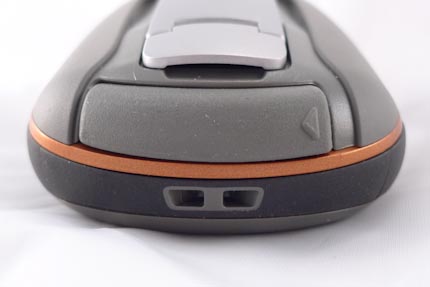
Only the battery compartment closure has a newly designed catch. The 7.6 cm (3 inch) diagonal touchscreen dominates the front of the unit. At the bottom of the case there is a small eyelet for fitting a wrist strap (sadly not supplied). Behind it, a rubber cover protects the mini USB port beneath (USB 2.0). On the right-hand side is the only real switch on the unit. Pressed briefly, this on/off switch also opens an extra menu for display brightness.
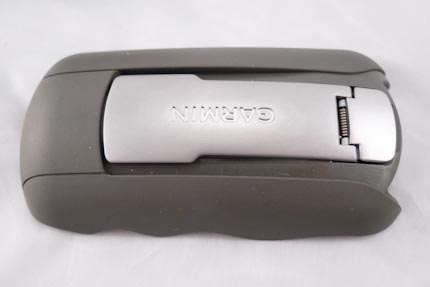
The back of the case has a mount for various holders, such as the supplied carabiner or, as an option, a car mount, bike mount, belt clip and so on. The entire back can be removed. Behind it is the battery compartment with the slot for a microSD card. The unit runs on two AA rechargeable or disposable batteries . Without batteries the unit weighs around 140 g. Ready to use with batteries it is about 195 g (230 g with the carabiner). The case makes a high-quality, sturdy impression; thanks to its shape it sits very well in the hand and allows one-handed operation for right- and left-handers alike.
 Since both the battery compartment and the USB port are well sealed, the unit can according to Garmin survive a dunking (waterproof to IPX7). We chose not to test that property. But going by experience with the predecessors and sister models, the unit can be left out in prolonged rain without any concern.
The Oregon 450 and 450t keep the proven operation of their predecessors
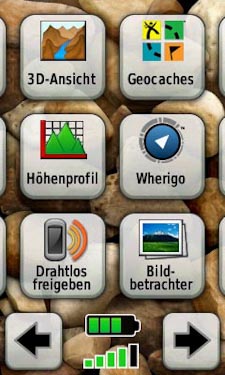
The new units have the same operating concept as their predecessors and as the smaller Garmin Dakota 20 as well as the models with a built-in camera (Garmin Oregon 550/t). In principle, as is usual with a car sat nav, all input is made through the touch-sensitive screen. Menu items and functions are therefore controlled by touching the screen.
In addition there is only the on/off switch, which also opens an extra menu for display brightness and for locking the touchscreen. Despite the large range of functions, the Oregon 450 is quite simple to operate. All menus are clearly laid out and can be used intuitively. Only for special requirements, and when it comes down to details, do you occasionally have to hunt a little for the right menu item. The display responds very precisely to finger contact. Only at the edges of the display do you have to press a little harder. Temperatures of minus 13 degrees, which occurred during the test period, did the touchscreen no harm at all, incidentally. Operating the touchscreen works without trouble with thin gloves too.
All the functions you need for hiking and trekking are there and easy to set. Anyone who has used a Garmin from the Oregon or Dakota range will find their way around the new ones immediately.
Technical data of the Garmin Oregon 450 / 450t
(extract from www.Garmin.com)
- Unit dimensions, W x H x D: 5,8 x 11,4 x 3,5 cm
- Display size, W x H: 3.8 x 6.3 cm (1.53 x 2.55 in); 7.6 cm diagonal (3 in)
- Display resolution, W x H: 240 x 400 pixels
- Display type: Transflective colour TFT touchscreen
- Weight: 143.0 g without batteries; 192.7 g with batteries
- Battery: 2 AA batteries; NiMH or lithium recommended
- Battery life: 16 hours
- Waterproof: yes (IPX7)
- Floats: no
- PC interface: high-speed USB 2.0 port and NMEA 0183 compatible
- Built-in memory: 850 MB
- Accepts memory cards: microSD™ card
- Waypoints: 2000
- Routes: 200
- Track log: 10,000 points, 200 saved tracks
- Electronic compass: tilt-compensated, 3-axis
- Barometric altimeter: yes
- Geocaching mode: yes (paperless)
- Custom maps compatible: yes
- Preloaded maps: yes (topographic) — Garmin 450t only
What is in the box with the Garmin Oregon 450 / 450t
- Oregon 450
- Carabiner clip
- USB cable
- User manual on CD-ROM
- Quick start guide
Maps on the Oregon 450 / Oregon 450t
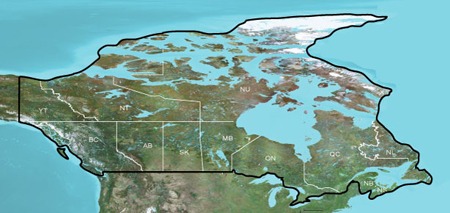
 The test unit, a Garmin Oregon 450, was fitted for the test with Garmin Topo Deutschland V3
Beyond that there are free alternatives too, some of comparable quality, although they are far from available for every region ( www.openstreetmap.org )
The display of the Oregon range: light and shade
 Now to the display of the Oregon — and with it straight to the most critical point of the current outdoor navigators from Garmin. Anyone who knows the “old” eTrex range or the Garmin GPSMAP 60CSx will rub their eyes at the first sight of this display and go looking for the function to turn up the brightness. Unfortunately you quickly discover that it is already at maximum. The display of the 450 series is unfortunately not really better than the version in the predecessor either. It is now a little glossier than the matt screen of the Oregon 300. That improves readability only when it is very bright (in sunlight, for example). By contrast, in the shade and in less bright conditions the display is unfortunately darker than its predecessor. At the moment we do not have a suitable comparison unit available, but the display appears to be exactly the same one used in the Oregon 550/550t.
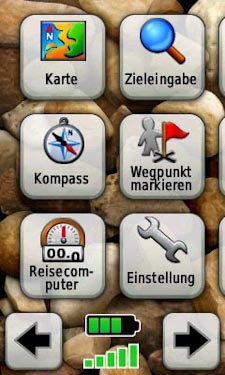 The backlight effectively has no function any more in sunlight. Depending on the viewing angle and the position of the sun, the display can be read more or less well, or not at all. For hiking and trekking this is not so much of a problem, since you can quickly change the angle of the Oregon relative to the sun. It is irritating all the same, especially if you are used to a better picture from older devices. Fundamentally, though, it has to be said that at the current state of the art a touchscreen probably cannot achieve the crispness that would be possible without the touch layer. In the mobile phone and smartphone sector, however, there are already devices that show what would be possible with a good touchscreen.
The display resolution of 240 x 400 pixels has not changed compared with the predecessors. It is considerably better than on the small Dakotas. The resolution makes it possible to take in a sufficiently large section of the map, so that navigating with the maps on the display works very well.
Reception quality of the satellite signals is good
Now to the reception quality of the Garmin Oregon 450. As might be expected, there are no surprises here. After a few kilometres in more and less difficult terrain, the Oregon can be credited with good to very good performance. Even under snow-covered conifers in the Harz the little navigator never lost satellite reception completely. The tracks — the recordings of the tours — were very accurate apart from small outliers. When the Oregon 450 was a little “off”, it was only by a few metres. For hiking these small deviations are really completely unproblematic. Only in exceptional cases, on tricky mountain tours for example, might this cause some head-scratching.
The new three-axis compass is one of the most interesting additions to the Oregon 450
 The new three-axis compass, which has already found its way into the other Oregon and Dakota models, is probably the most interesting new feature. This electronic compass points the way reliably even when the unit is not held completely level. That is a big step forward compared with the “older” Garmin devices. To be able to use this three-axis compass really reliably in difficult terrain, though, the unit unfortunately lacks a sighting device. Only with such a mark on the unit can the direction shown be transferred reliably onto the terrain. So in the end it remains a rough aid to navigation. In the admittedly short test period the compass worked very reliably and without failures.
The good battery life is sufficient even for long walks
Garmin quotes battery life at 16 hours. Going by experience with the sister models and predecessors, that figure can be considered realistic. With appropriate use of the power-saving functions in the menu, even longer run times can be achieved while hiking. The condition for that is that you do not constantly wake the display to look at the map when it has just gone into standby. Battery life is therefore certainly absolutely sufficient for use on day walks. On longer trekking tours you will of course have to think about how to resupply with power along the way. For other uses, such as on a mountain bike, where full display backlight is always needed and the display does not switch off, a considerably shorter run time is to be expected.
In the short time available, unfortunately no realistic run-time tests were possible. We will supply those figures later.
 What else stood out positively about the Garmin Oregon 450t:
- 850 MB of built-in map memory (a further 4 GB possible via SD card)
- Fast data transfer thanks to the USB 2.0 port
- Storage for up to 2000 waypoints and 200 routes
- Storage for up to 200 saved tracks with up to 10,000 track points each
- Dedicated geocaching mode
- User-specific profiles
- Can display self-made raster maps, aerial and satellite imagery
Verdict:
Garmin Oregon 450 / 450t: tough and good, but not innovative
 The reception characteristics and the track logging of the Oregon range are beyond reproach. The important functions for navigating while hiking and trekking are there, and given the extensive feature set, operation is very well solved. The display has a good resolution that allows excellent map rendering and easy use of the menus. Unfortunately the display is not as bright and high-contrast as one would wish.
For newcomers to outdoor navigation the 450 models are absolutely recommendable. GPS enthusiasts and geocachers can take to the new Oregons too. Anyone still out with the “old” eTrex or 60CSx may need a little longer to warm to an Oregon. For anyone already using an Oregon 300 / 400t, the upgrade is only worth it if they really need the three-axis compass. The other changes certainly do not justify the switch. Compared with the Dakota, the Oregon range scores with a distinctly larger and better display, though at the cost of slightly less run time, more weight and larger dimensions.
The price of the 450 series is still a little high at launch, even if they can already be had well below Garmin’s recommended price. The sister models with a built-in camera, the Oregon 550/550t, are barely more expensive, though. The price will therefore probably have to come down a little more quite quickly, otherwise the 550 series is the more attractive choice. Our estimate for the coming weeks: around EUR 300 for the 450 and EUR 350 for the 450t.
 UPDATE 30.01.2010: After the Oregon 450 was carried a few kilometres through deep snow again today, together with the old 300, the statements above are confirmed. Run time is practically identical to the predecessors Oregon 300/400t and to the sister models of the 550 series. Reception and the tracks are very good, although because of the season they could of course only be tested in snow-covered spruce forest and not in dense deciduous woodland. In practice, under a cloudy sky, the display is by no means better than that of its predecessor.
 It is a little darker, as you can see from the picture (click to enlarge). In better light, that is when the backlight no longer comes into play, the relationship is exactly the other way round and the new model can make up some ground. Note: In the pictures the Oregon 300 is fitted with a screen protector. That affects the rendering of the display only minimally. The Oregon 450 has no screen protector.
Update 16.02.2010:
— firmware updates available for Oregon 450 and Oregon 550
Pros, Oregon 450:
- simple operation
- three-axis compass
Cons, Oregon 450:
- display brightness
- (for now) comparatively high price