
 A new rugged hiking boot for tours away from wide forest tracks was on my wish list. The new one was meant to partly replace my Hanwag Tatra trekking boots, which seemed a bit too “sturdy” for some lighter tours without a heavy backpack. So the new one was supposed to be somewhat lighter and more flexible. Even so, I wanted quality and features similar to the Tatra.
So the hiking boot was also supposed to be made of leather, without a “sweat-inducing” membrane, so that it would still be comfortable to wear in mostly dry and very warm weather. Of course it should also survive a rainy hike without immediately turning into a bathtub for my feet. A proper treatment with wax to make the leather trekking boot waterproof – or nearly waterproof – beforehand goes without saying.
The Hanwag Omaha hiking boot
 Once again the choice fell on a Hanwag boot: the Hanwag OMAHA is described by the manufacturer as a “comfortable, versatile all-round hiking boot”. To get it out of the way right at the start, the weight saving I was hoping for compared with the Hanwag Tatra is unfortunately a bit meagre for my taste – the Omaha weighs only just under 90 g less per boot (740 g instead of 830 g in size 43).
To put this into perspective, though, it has to be said that the Tatra, considering its robust build, good workmanship, stable sole and very good lateral support, is actually a relatively light trekking boot. So the Omaha certainly doesn’t have an easy job saving a lot of weight on top of that without major compromises in these areas.
Details of the Hanwag Omaha
- Sizes: 6 -13
- Weight: 660 g in size 7.5 (my own measurement in size 43 / 9.5 = 740 g)
- Colours: ash, earth
- Upper: waxed nubuck
- Lining: leather
- Sole: Vibram® Endurance
- firm trekking insole board
- fine nubuck upper and glove-soft leather lining
- comfortable trekking last
- synthetic insole board
- grippy, durable Vibram sole
The Hanwag hiking boot is superbly made
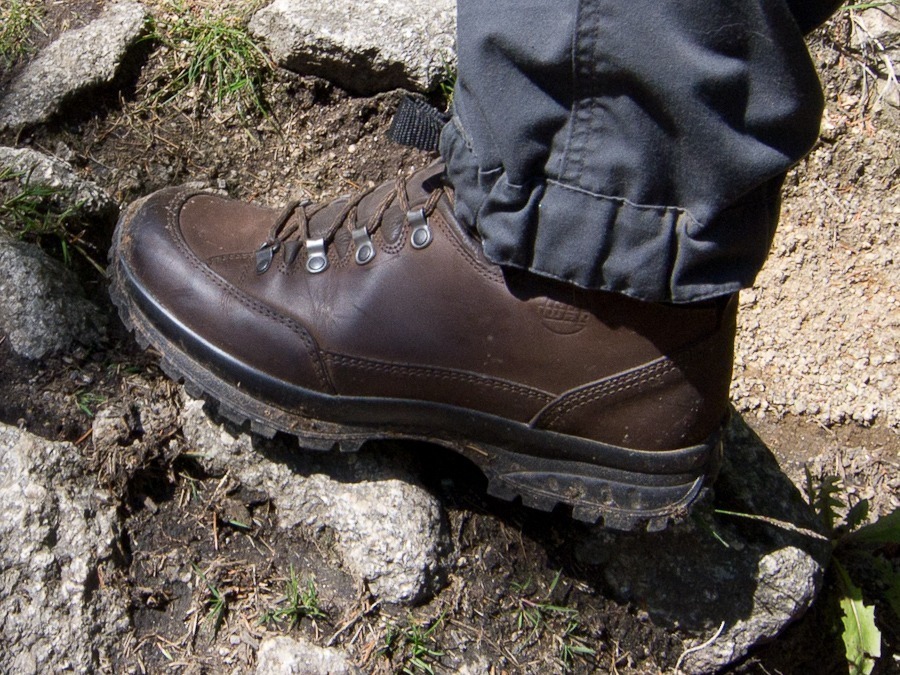
 When you take the Hanwag out of the box, the first thing you notice is that, compared with many a lightweight “synthetic” trekking shoe, it doesn’t smell unpleasant. It doesn’t reek of evaporating glue or plastic, even though plastic and glue were of course used here too (e.g. for the sole). The next thing that catches your eye is the great workmanship of the leather. All the seams are very clean and precisely done. The bond to the sole shows no gaps or excess glue – I’ve seen otherwise!
The Vibram® Endurance sole is familiar from the Hanwag Kharta / Tingri, or at least the tread pattern looks identical. It has a fairly chunky tread with a lug depth of approx. 5 mm. The sole is turned up slightly at the front and rounded upwards at the heel. Otherwise, the sole or its rubber is not pulled up any further and therefore offers no scree rand or protection for the forefoot. However, the leather in this area is quite thick, so any damage and scratches will probably mainly affect the looks. But it is clear that the Omaha is not designed for long mountain tours on sharp-edged Alpine scree.
Testing and experience with the Hanwag Omaha
 Right after buying them, the boots were treated with Sno-Seal leather wax (see: Care tips for leather hiking and trekking boots). Right from the first time you put it on, the boot, lined on the inside with soft leather, feels pleasant. The lacing can be adjusted quickly and easily.
The Omaha’s first outing was a 3-hour hike in the Oker valley in the Harz. A steep climb, gravel forest tracks and a somewhat slippery descent on a narrow path. You feel comfortable in the Hanwag from the start, although it is of course still a bit stiff at first. That is perfectly normal for leather boots, though. After a few hours, i.e. already at the end of this first hike, it feels a little softer. The sole has good grip on gravel, in muddy terrain and on wet grass. Its grip on wet rocks and roots is not quite as good. Overall, however, the sole’s grip is at a high level. The support inside the boot is very good for the height of the shaft and the weight class of this hiking boot.
The next hike took the Hanwag Omaha through the Ilse valley up the Brocken, the highest point in the Harz. With a few exceptions, it mostly follows wide gravel forest tracks. The Omaha handles these confidently too. The sole construction is not too hard, and thanks to the rounded heel area the boot rolls well. Overall, though, it has to be said that the boot is actually a little too sturdy for this – you could easily walk a route like this in an even lighter shoe.
The third test hike the Omaha had to endure took it to the Alps: a mountain hike near Garmisch-Partenkirchen to the Brünstelskopf and the Enningalm. The weather was very changeable: the ascent led, in pouring rain, over a steep muddy meadow path among other things. On the way along the ridge there was a hailstorm, and then on the alp – plenty of sunshine. The boot had a good inner climate in all weathers. The rain stayed out – despite relatively long stretches through mud and wet grass. In the afternoon sun on the alp, the lack of a membrane paid off – my feet weren’t “soaked with sweat” afterwards. On this somewhat more demanding hike, too, the boot was comfortable to wear and not too heavy, with good lateral support and sole grip. The hike was actually almost ideal for the boot: from firm gravel forest tracks to a rugged but not too wild mountain path and, elsewhere, boggy alpine meadows – it had almost everything.
In my experience, the climate comfort in warm temperatures is definitely much better than with membrane boots. Despite the generous coat of wax, the breathability still seems to be quite decent.
The Hanwag Omaha compared with the Hanwag Tatra
Hanwag places the Omaha one class below the Tatra – rightly so! The sole is somewhat softer and the stability can’t quite match the Tatra either, so the Tatra has the edge in difficult terrain. The sole grip of both models is at a similarly high level, at least on gravel, in mud and on wet meadows. On wet stones and rocks, however, the Tatra is clearly ahead (here it performs better than any other shoe I have worn so far). On firm forest tracks, on the other hand, the Omaha is the winner – it rolls better and more softly than the Tatra.
My recommendation: if you often walk on firm, even paths and don’t carry much luggage, but do occasionally make an extended detour into more difficult terrain, the Hanwag Omaha will serve you very well. Here you also benefit from the slightly lower weight. But if you often carry heavy loads (over 15 kg) and/or avoid firm forest tracks as much as possible, you shouldn’t shy away from the extra weight and should go for the Hanwag Tatra.
Assessment of the Hanwag Omaha
 As already indicated above, the boot is suitable for a wide range of uses. Of course, for hikes only on firm, even paths, a lighter shoe would do. It is also clear that on tours exclusively in rough terrain, a little more stability would be desirable. But the Omaha still does its job well in all cases and can therefore be used quite universally. The lacing runs smoothly and can be adjusted precisely.
In warm weather the climate inside the boot is better than in membrane boots, and in the rain a well-cared-for leather boot stays dry for a long time. The workmanship of the hiking boot is very good – with good care, nothing seems to stand in the way of many years of use. Then the not exactly cheap purchase price will soon be forgotten!