

 Hiking poles? Aren’t they just for “old men” who can only drag themselves over the mountain with their help?? That, or something like it, is what many people thought when the subject of trekking poles came up. But once you get over this prejudice and have gained some practical experience yourself, you quickly come to see trekking poles as a great thing and soon won’t want to be without them. At least once you have found the right pair and, after a period of getting used to them, learned how to handle your trekking poles. But how do you find the right trekking poles, and what should beginners in particular look out for before deciding what to buy?
According to medical studies, trekking poles take the strain off the ankles, knees and hips, especially on long descents. Accidents while hiking and trekking are usually caused by slipping on slippery surfaces or by twisting an ankle on uneven paths. Used correctly, hiking or trekking poles always give you an extra “leg to stand on”, which considerably reduces the risk – though of course it cannot eliminate it completely. If that isn’t enough for you, here are some further advantages:
- a safety margin when crossing streams and rivers by probing ahead and supporting yourself with the poles
- uphill, targeted support for the leg muscles makes going easier and faster
- on difficult passages and sections, trekking poles help you keep your balance
Getting a grip
Does the trekking pole sit well in the hand? Is the grip non-slip? These are questions you shouldn’t overlook when buying. You certainly don’t want to hold something in your hand for hours that feels as “good” as a stick picked up off the ground. Trekking pole grips come in various materials such as foam, rubber and cork.


The grips should sit well and securely in the hand and should be neither too big nor too small for your own hands. It is also important that the grip doesn’t get slippery when your hands get sweaty. Otherwise you run the risk of slipping off at exactly the moment you can least afford it. With no-name manufacturers and “discount store” offers in particular, you should take a close look at the grips, because hard plastic is sometimes still used as the grip material. The grips are often angled slightly forward. Here too, you should check for yourself what suits you best, because even different models from the same manufacturer have grips angled to different degrees.
Another point worth attention is the wrist strap. It should be soft and comfortably padded so that it doesn’t chafe on longer hikes. At the same time, of course, it should also be strong enough not to tear under load. In addition, the length of the wrist strap must be quick and easy to adjust without the mechanism giving way involuntarily under tension. A grip extension below the actual handle is also a useful thing. On short climbs you can then simply grip a little lower without having to shorten the pole straight away.
Aluminium or carbon
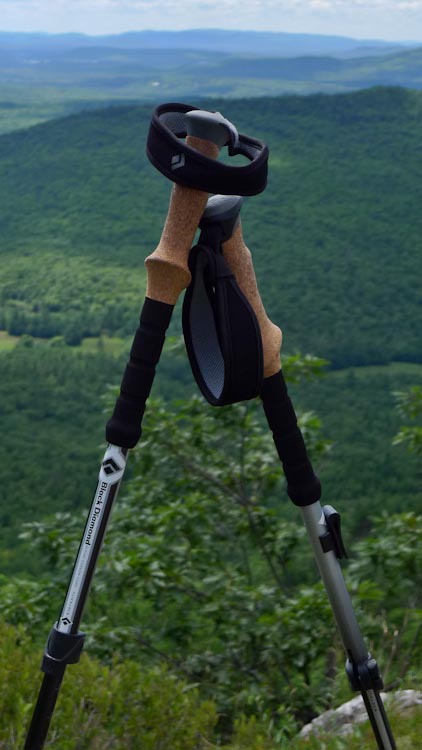 Carbon trekking poles: Carbon is a carbon-fibre-reinforced plastic that is very light and at the same time very strong. Trekking poles and ski poles made of carbon have the “disadvantage” that, in extreme cases, they don’t bend but break straight away. If you don’t like the oscillation / vibration of aluminium poles after planting them (which occurs to a greater or lesser extent with all aluminium models), a carbon trekking pole is basically a good choice. The material absorbs vibrations better than aluminium and eliminates them quite effectively. A fairly sturdy and comfortable carbon model is, for example, the Black Diamond Alpine Carbon Cork, which we have tested.
Aluminium trekking poles: If aluminium is used, the poles are usually somewhat heavier. With a bit of luck, aluminium poles that bend under excessive load can simply be bent straight again if the damage is minor. Due to the nature of the material, aluminium trekking poles vibrate more than carbon models. If aluminium models get wet on tour, you should take them apart and dry them to prevent the aluminium from corroding.
In general, aluminium models are somewhat cheaper than comparable carbon trekking poles.
The adjustment mechanism – quick adjustment or annoying fiddling
With trekking poles it is also important that you can quickly adapt the pole length to the situation at hand. The adjustment mechanism is anything but unimportant and should definitely be tested thoroughly before buying.
There are basically two adjustment systems
1. Twist locks: twisting the pole sections against each other releases or locks the clamping mechanism inside the pole.
2. Lever locks: flipping a lever opens or closes a clamp on the outside of the pole.
Cheap trekking poles from discount stores in particular often use a twist lock for adjustment that soon gives up the ghost or even slips unintentionally. This can not only be very annoying but can also become quite dangerous in difficult situations when you are relying on the pole. The old pair of trekking poles in my cellar proves that a “cheap” twist lock is not the best choice for trekking poles: the locks are completely stripped and it is almost impossible to lock the pole in place.
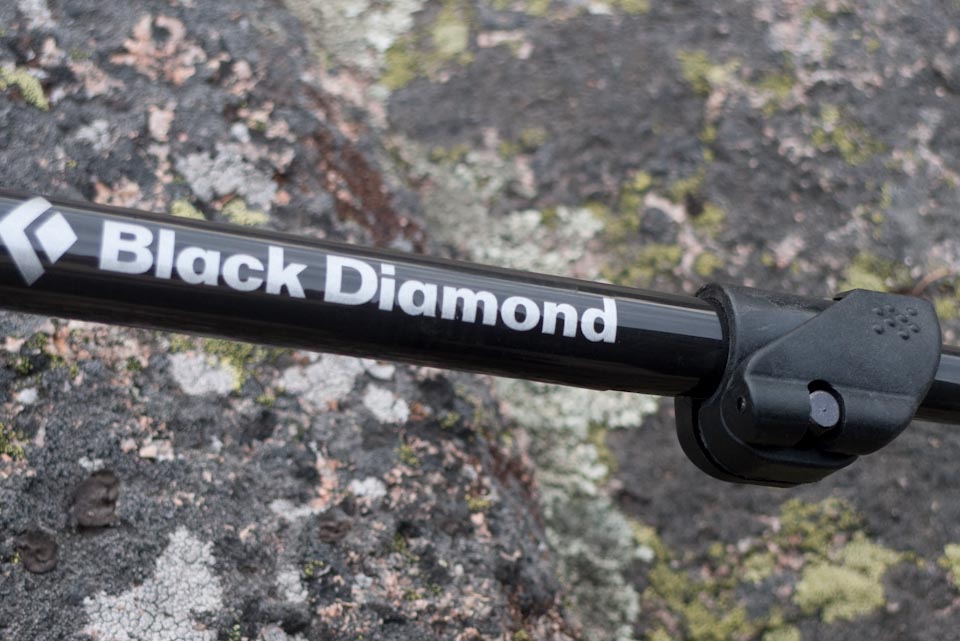 The Black Diamond trekking poles we have already presented (Trail Ergo Cork, Alpine Carbon Cork) offer, with the FlickLock system, a simple and fast way of adjusting the pole length to your personal needs. With the FlickLock system, the length of the pole is fixed by a lever system. But twist locks such as those used by Leki are also perfectly usable and lock reliably. However, adjusting them takes a little longer and can become a problem in frost with frozen poles.
Comfortable softie or rock-hard precision pole?
The latest trend in trekking poles is sprung or shock-absorbing models, which are offered by all manufacturers. In principle, the suspension increases comfort because it reduces the pressure and strain on the hands and wrists every time the pole is planted. Depending on the pole, the suspension is harder or softer. On some models you can also adjust the stiffness or even switch it off completely. The disadvantage of shock absorption is that the poles cannot be placed quite as precisely and the weight increases slightly. On longer tours in particular, however, the shock-absorbing models are recommended. They also reduce somewhat the oscillation on planting that occurs especially with aluminium poles.
Size matters too
What use is the best trekking pole if it is simply too short for someone who is 1.90 m or even taller? But what is the optimum length to look for when buying a trekking pole? You can approximate the optimum pole length with a simple mathematical formula: multiply your height by 0.68. For a person who is 1.70 m tall, the optimum pole length would therefore be 115.6 cm (170 cm * 0.68 = 115.6 cm).
However, this calculation does not take into account that everyone’s arms are a different length, which is why it can only be used as an approximation of the length you need. The easiest way to find out is to take a pole, grip it by the handle while standing upright and plant it on the ground. The angle between the upper arm and forearm should be about 90°, with the upper arm resting against the body, of course.
Hold the trekking poles in your own hands
The most important thing is to have held the trekking poles in your own hands before you decide to buy.
Tests on the internet give you good orientation, but in the end you should check for yourself which model you get on with best.




