
 When you are out alone in a remote region with no mobile reception, the question quickly arises – what do I do if something happens? How can I call for help? OK, there are nice “tools” such as a signal mirror or a whistle to send a light or sound signal – but does that really help you out in the wilderness? Many tips from various survival guides are quite interesting – but unfortunately rarely really helpful. Isn’t there a technical aid after all???
SPOT – the world’s first satellite messenger
If you believe the manufacturer’s advertising for the Spot Satellite Messenger, the orange device can transmit satellite-based messages written in advance and can also send an emergency signal that is received by a “rescue coordination centre”. The small device would thus give you an emergency beacon that reliably summons help even in “uncivilised regions” of the world. Reason enough for us to test the Spot Satellite Messenger.
Introducing the SPOT Satellite Messenger
 The SPOT Satellite Messenger is primarily designed as an emergency beacon. Beyond that, there are also some additional functions that are meant, for example, to let those “left at home” follow your trips. Especially if you plan to travel alone in remote areas of the world – which does happen on treks now and then 😉 – the device is certainly an asset.
The SPOT is said to work almost worldwide, including Europe, the North American continent with the USA, Canada and Mexico, Australia, parts of South America, North Africa and north-east Asia, and hundreds of thousands of miles around these areas.
A coverage map can be found here:
www.findmespot.eu/gm/coverage.php
More than just an emergency beacon….
The SPOT’s functions in detail:
- 9-1-1 alert – emergency call with exact position.
The SPOT sends an emergency signal every 5 minutes until the power is cut or the alert is cancelled. - Ask for help – ask friends and family for help at your exact location. For one hour, the SPOT also sends a short pre-written message every 5 minutes to previously defined e-mail recipients
- Check in – the SPOT sends a pre-written “OK message” to the previously defined e-mail recipients
- Track progress – the SPOT transmits every 10 minutes, stores your position and lets the chosen group of people follow your route online with Google Maps™.
It is very important to know that buying the SPOT alone does not let you use any of these services! Without paying the provider extra money, the device is practically worthless. An annual fee of currently 99 EUR has to be paid to use services 1-3. Service number 4, “Track progress”, is only stored and displayed if you pay the provider another 39 EUR. Together with the purchase price of 199 EUR, that adds up to a hefty total of around 340 EUR in the first year. So all in all not a cheap undertaking, especially if you only go on one big trip a year.
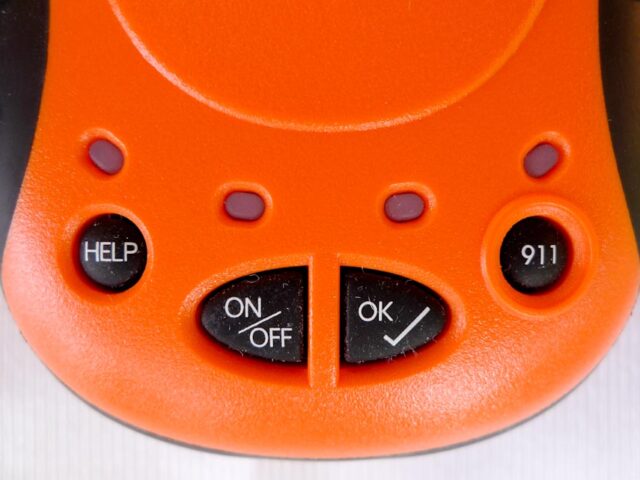
Recessed buttons prevent accidental activation of the emergency call
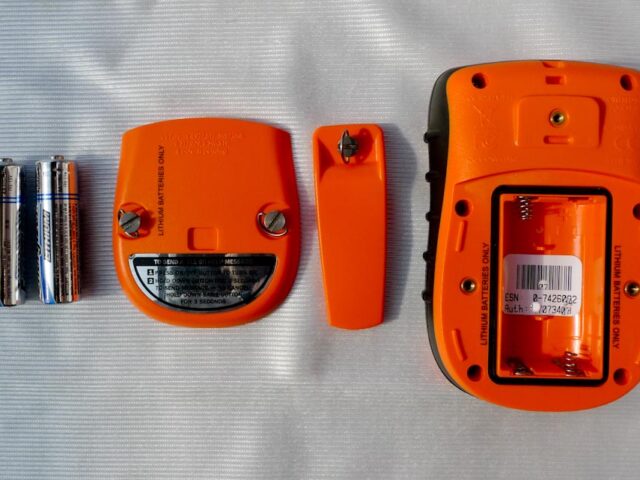
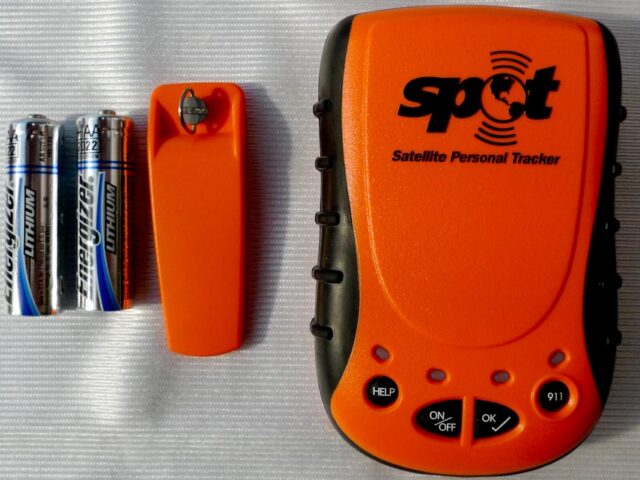
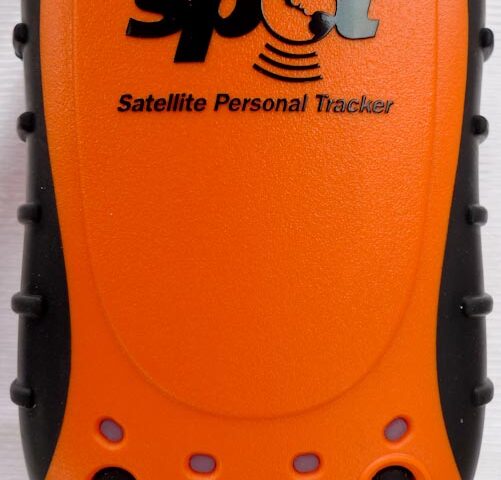
 On the front, besides the large logo, there are 4 recessed buttons: an On/Off button, an OK and a Help button, as well as the 911 button, which is recessed a little deeper into the housing so that it isn’t activated by accident. Above them are 4 status LEDs that show the state / activities of the device. The battery compartment is on the back of the SPOT. The battery cover is fixed with two screws, which can also be undone by hand thanks to a small fold-out handle. Above it is the belt clip, which is also secured with a screw. To protect against loss, there is also a small eyelet where you can attach a wrist strap or similar in order to additionally secure the SPOT satellite GPS messenger, e.g. with a carabiner.
Operating time of the satellite messenger
Battery life (manufacturer’s figures)
2 AA 1.5V lithium batteries; with normal use of fully charged batteries, they should last as follows:
* Switched on, not in use: about 1 year
* Track progress (SPOTcasting) mode: about 14 days
* 9-1-1 mode: up to 7 consecutive days
* Check in (SPOTcheck OK): 1,900 messages
* Ask for help (OK): 1,900 messages
Size and weight
Size: 111 mm x 69 mm x 44 mm
Weight: 208 g
 The first impression when unpacking the SPOT is definitely positive. With its plastic housing in orange signal colour, the device feels very solid, which is surely also due to its rather high weight. The screws of the belt clip and the battery compartment are easy to undo with the small fold-out handle. The buttons are easy to press; only with thick gloves will you have trouble pushing them all the way down. The LEDs are easy to see even in sunshine. However – and more on this later – that doesn’t always help you…
The SPOT Satellite Messenger in practice
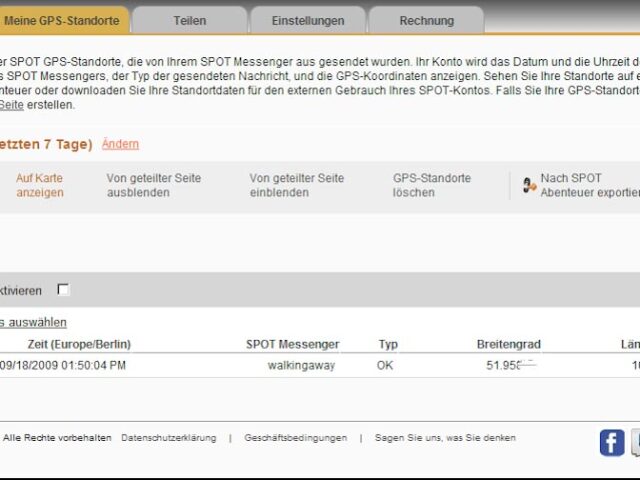
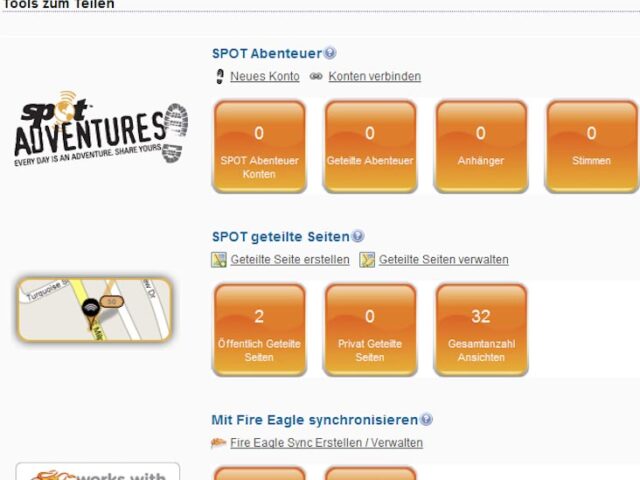
 Now to practice – first we have to create an account on the website http://www.findmespot.eu/gm and select the relevant services. To set up the account you need the device at hand, and you enter the device number shown in the open battery compartment. The services are paid for by credit card. The site’s menu is clearly laid out and relatively straightforward. Unfortunately, some translations in the customer menu are not entirely clear, but overall registration is relatively unproblematic and done quickly.
Now we set up one or more e-mail or SMS recipients both for the OK message and for Ask for help . The recipients then receive the pre-written messages, which can also be configured in the same menu.
The rugged device only runs on expensive lithium batteries
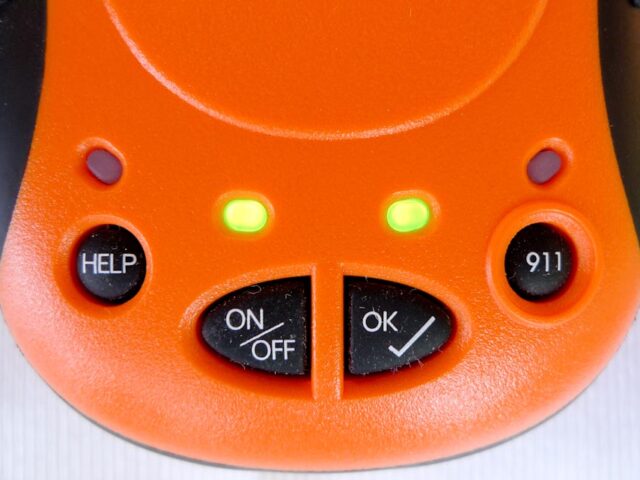
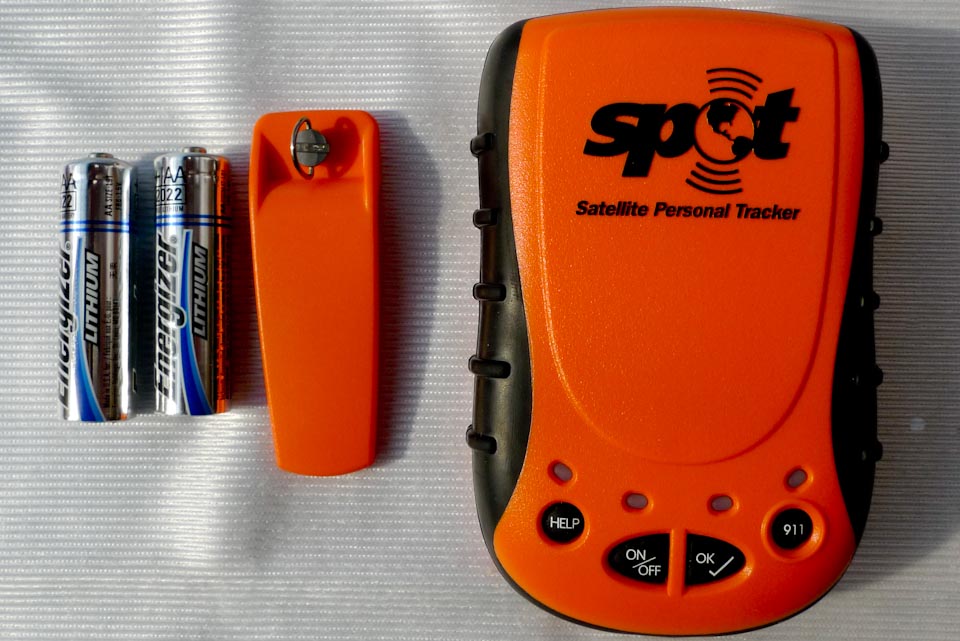 Now to practical handling: all we need to do is insert the supplied 2 AA 1.5V lithium batteries into the device and switch it on. The device is then ready for use – recognisable by the LED above the power button briefly flashing green every three seconds. By the way, only lithium batteries may be used; normal AA rechargeables or batteries are not suitable.
After switching it on, we leave the device for a few minutes in a spot with an unobstructed “line of sight” to the satellites, so that the device can first “get its bearings”. After about 10 minutes we briefly press the OK button. Shortly afterwards the LED above the OK button also flashes green. The pre-written OK message should now be sent to the chosen recipient. The device should stay switched on for quite a while after activating the function, so you can be sure the message has actually been sent! Unfortunately, there is no indication at all from which you could tell that the message has actually “gone out” correctly! The Ask for help function is activated in exactly the same way via the “Help” button.
Messages are sent by e-mail and SMS
After about 10 minutes the message is in our inbox. This is the result of a first test under optimal conditions: it was a clear day and the device was in a position with a very good “all-round view”. No mountains, trees or other obstacles blocked contact with the satellites. In addition, the device stayed in one place and was not moved. In further practical tests there were unfortunately considerably more problems sending messages. With even slightly worse “reception conditions”, messages often weren’t sent at all.
A very good “line of sight” to the satellites is necessary

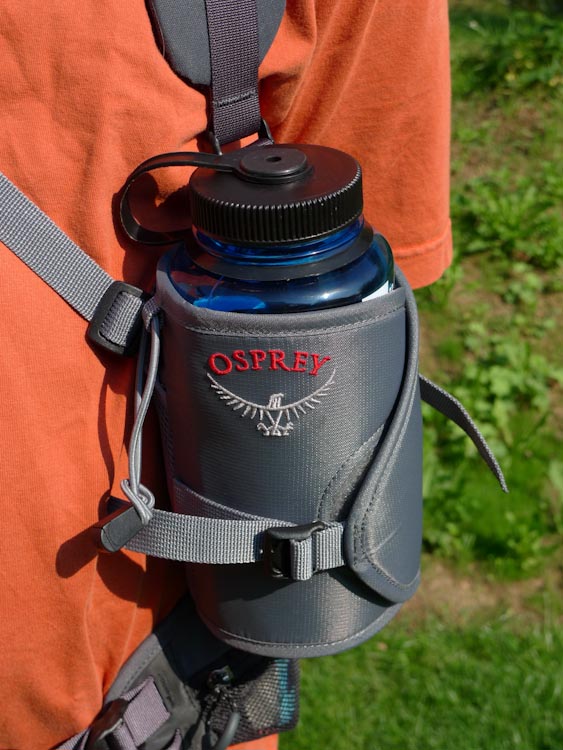
This is also confirmed with the tracking function. Here too, you only get reliable results if the route leads through open terrain and the SPOT Satellite Messenger is carried as high up as possible (e.g. on the backpack lid). Attaching it to your belt is not suitable for reliably getting a signal.
When hiking through forest or in valleys, in our tests almost no message or position signal was ever sent! So after a few tests with the SPOT Satellite Messenger, the interim result is somewhat mixed.
The picture alongside (click to enlarge) shows a typical tracking record of a hike in the Harz. Only in the section where the path runs across completely open ground are all track points present. The purple line shows the actual route of the hike.
Preliminary verdict on the SPOT Satellite Messenger
Problems in practice…
In terms of its features and concept, the SPOT Satellite Messenger makes a very good impression! The website used to set up and configure the satellite messenger is also well made! In the practical tests so far, however, the SPOT Satellite Messenger unfortunately could not fully convince. It is affected by poorer reception conditions much more quickly than, say, current outdoor GPS units. With a clear view of the sky, the device did its job reliably and all messages were sent promptly. For obvious reasons, we did NOT test the 9-1-1 alert – (after all, we didn’t want to trigger a rescue operation as part of the test ;-). But since this emergency call is technically based on the same foundation and only triggers a different response than sending a message, it is safe to assume that the reliability of this function is the same.
We will continue to test the SPOT Satellite Messenger intensively over the coming weeks. Among other things, it will have to prove itself in the eastern USA from the beginning of October. That is why this is only a preliminary verdict.
Pros:
- no comparable device concept on the market
- practical functions, not just for emergencies
- easy configuration via the clearly laid-out website
- robust construction
Cons:
- relatively large and heavy device
- operating concept not always intuitive
- no feedback as to whether messages have actually been sent
- mediocre satellite reception