
 While looking for a lightweight mid-cut hiking shoe with a membrane I came across the Merrell Moab Mid GTX Men. The “technical data” and the look suggest that the shoe should be well suited to the intended use. The price of under EUR 100 makes it interesting too. Trying it on in the shop, the Merrell Moab Mid is convincing. Out on the trail in the eastern United States, however, it shows its weaknesses.
What the Merrell Moab Mid GTX is
The Merrell Moab Mid is a waterproof shoe made of synthetic leather and breathable mesh. Inside, a breathable Gore-Tex lining surrounds the foot. The removable, anatomically shaped Ortholite® footbed has an antibacterial treatment. Shaft and tongue are softly padded with a synthetic lining. A midsole with air cushioning is meant to absorb impact. The well-lugged Vibram outsole, drawn up at toe and heel, promises good grip on the trail. The weight of the pair is approx. 970 g in size 43 (UK 9).
The Merrell Moab Mid and its weak points on the trail

When trying the shoe on in the shop I went one size up from what I normally wear. The length of the Merrell would still have been fine, but the shoe was very tight around the forefoot. The shop assistant confirmed that these shoes come up small and that most people go one size larger.
On the first short tour, in dry weather and on fairly level paths, the Moab makes a good impression. It is relatively light and still offers decent lateral support. The Vibram sole is well cushioned and the grip on dry ground is simply excellent. Whether on steep sandy sections, mud, gravel or leaves, you always feel secure. Beyond that, the sole is stable enough for a lightweight hiking shoe to cope with short rocky sections without stones pressing through too much. This is, of course, where the limits of a light shoe become clear. Ventilation of the Moab is very good for a shoe with a membrane, thanks to the “airy” construction with plenty of mesh.
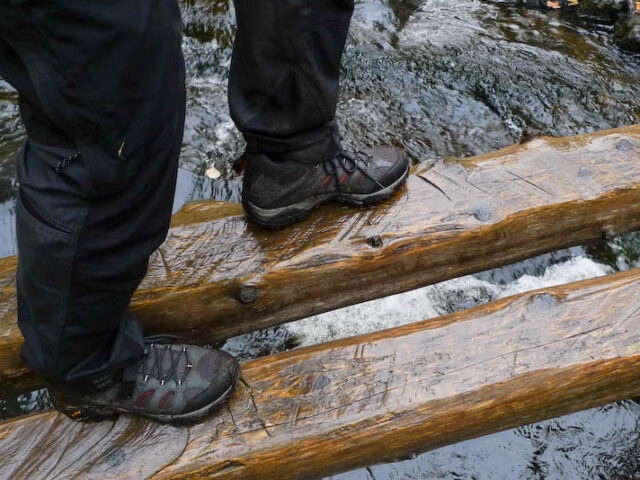
The first wet-weather tour starts well too. Thanks to the Gore-Tex membrane, puddles, mud and wet grass are no problem. The shoe keeps the water out. Muddy sections are easy to handle with the grippy sole. Then comes the setback: on wet rock and roots the sole is very slippery. This is certainly a particular challenge for any shoe, but it is noticeable that the Merrell Moab has trouble with traction here. In a direct comparison with other models I usually wear, from Hanwag and Adidas for example, the Merrell simply started to slide sooner. Vibram makes soles with better grip than this one.
 On some more demanding trails in Acadia National Park in the eastern United States the shoe had to show what it can do once the terrain gets harder. Unfortunately it did not take long to notice that the shoe stretches a great deal around the forefoot.
Where it still fitted in the shop, it widened more than average over the first few tours. That is surely down to the airy, lightweight construction of the shoe. Of course you can correct this to some extent by lacing more tightly. But the more kilometres it had on it, the harder that became. The simple lacing could not always compensate enough. Before long there was no longer much to be said for lateral support around the forefoot.
Looking back, the question is whether the “too tight” shoe one size smaller would not have been the better choice in the long run. The cushioning of the Moab stays good even under heavier loads, though, and the waterproofing of the shoe is beyond reproach.
Verdict on the Merrell Moab Mid GTX Men

The Moab leaves a mixed impression. In dry weather the grip of the sole is convincing at all times. In mud, too, the heavily lugged sole does its job well. But on paths with wet rock you have to be very careful in the Moab.
The lateral support of this lightweight hiking shoe is absolutely fine when new. Once the shoe has been in use for a while, though, the “thin” material stretches quite a lot – the shoe becomes wider, especially around the forefoot. If you take that into account when buying, you get a comfortable, lightweight hiking shoe at a good price that can also handle the occasional excursion into difficult terrain.
Pros:
- Light
- Tough, grippy sole in dry conditions
- Good breathability and waterproof
- Good value for money
Cons:
- Sole slippery on wet rock
- Shoe stretches a lot