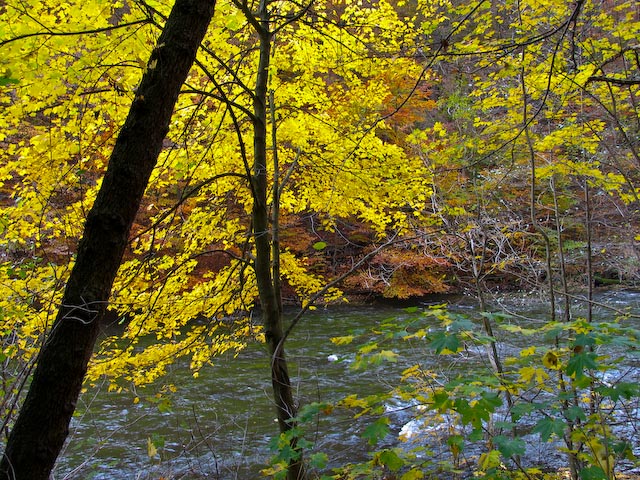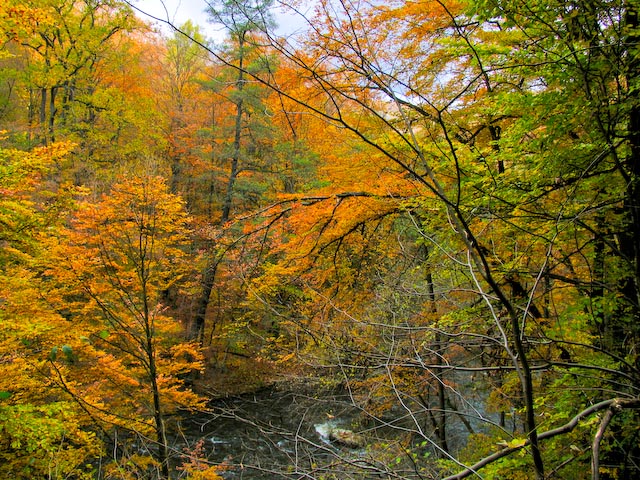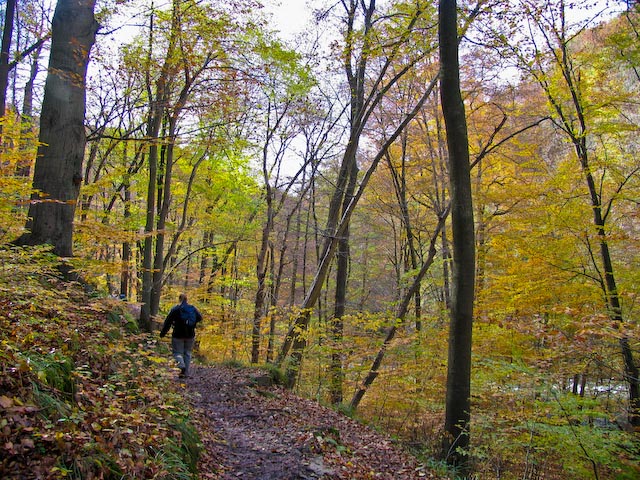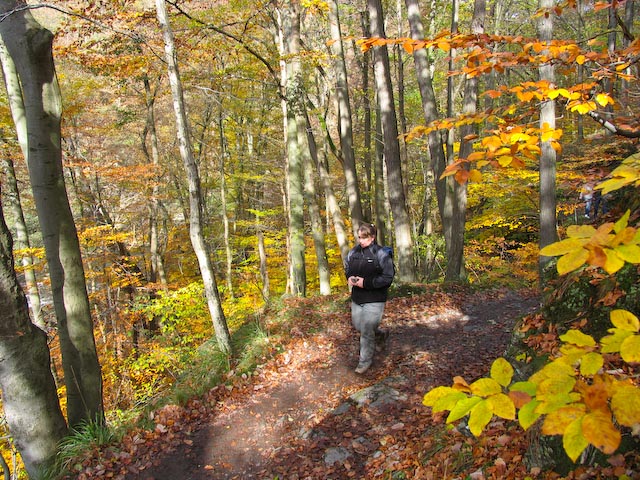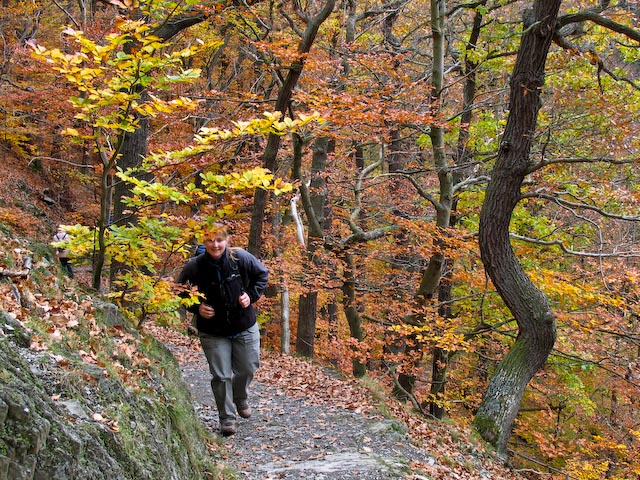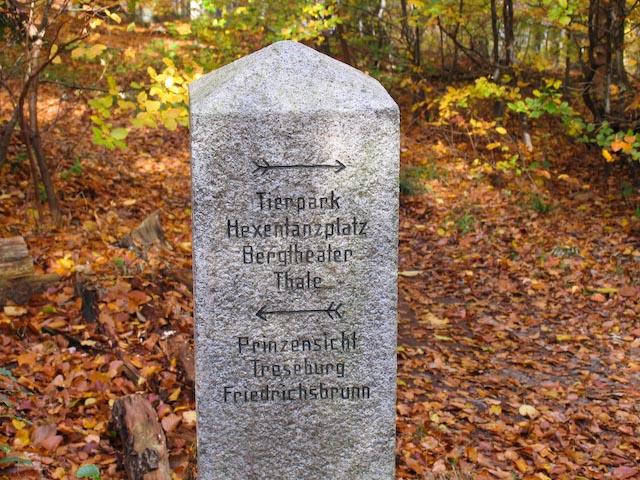

A very beautiful, almost picturesque walk. Highly recommended in autumn in particular, when the leaves are turning! We set off in glorious sunshine just before the wildlife park at the Hexentanzplatz. There is a paid car park there as well (currently EUR 4). Since the Hexentanzplatz is a very popular destination, there is of course a lot going on.
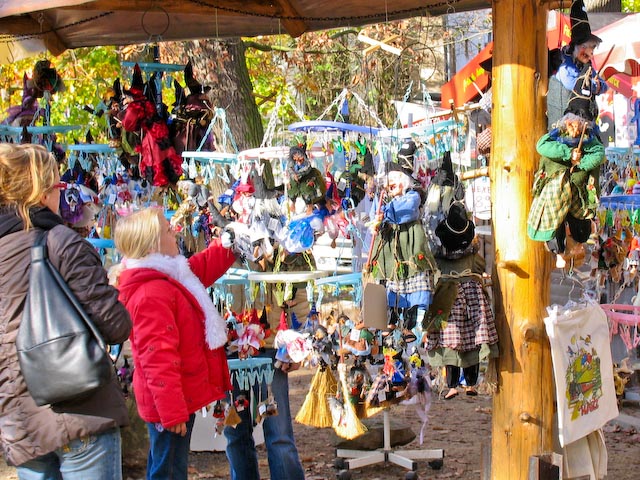
There is a bobsleigh run, a cable car (from Thale), plenty of stalls, a carousel, the Harzer Bergtheater open-air theatre, the Walpurgishalle museum and a wildlife park. I have to admit that we looked for a free parking spot on the L240 instead, right beside the trail.
Our route first led through the forest right along the fence of the wildlife park. Even a wolf showed itself. A signpost points to the La-Vieres-Höhe viewpoint 200 m away, high above the Bode. The view is magnificent. From here you stand directly opposite the impressive, almost vertical granite walls of the Rosstrappe and can see the Hirschgrund down in the valley.
The legend of the Rosstrappe
The story goes that, fleeing the wild giant Bodo (king of Bohemia), the beautiful princess Brunhilde saved herself with a daring leap on her horse across the deep valley of a mountain stream to the rock on the other side. She reached it only with difficulty; the imprint of her horse’s hoof can still be seen today, hence the name Rosstrappe, “horse’s hoofprint”. In doing so she lost her crown, which fell into the valley of the stream together with King Bodo – the stream has borne his name ever since (“Bode”). Transformed into a dog, he guards the princess’s crown in the Kronensumpf marsh there to this day.
Then we fought our way through the crowds at the Hexentanzplatz (information about the Hexentanzplatz can be found here: http://de.wikipedia.org/wiki/Hexentanzplatz_%28Harz%29). It was a Saturday and busy accordingly.
From here you get an unusual view into the valley. The deep, narrow cut the Bode has made tempts you to call it the “Grand Canyon” of the Harz.
It only gets quieter shortly before the Harzer Bergtheater. We descend towards Thale on the Jägerstieg, which is strenuous in places but very beautiful. The path winds along granite walls and crags, partly over natural stone steps, then becomes gradually gentler until we arrive at a small dam down in the eastern side valley of the Bode and enter the town of Thale on Walpurgisstraße.
Thale
(original name: Dorp to dem Dale)
More information about Thale: http://de.wikipedia.org/wiki/Thale
After about 300 m we turn off Walpurgisstraße into Rudolf-Breitscheid-Straße to get into the Bode valley. After another 400 m we go left off Hubertusstraße, which passes the Friedenspark and leads straight to the Bode.
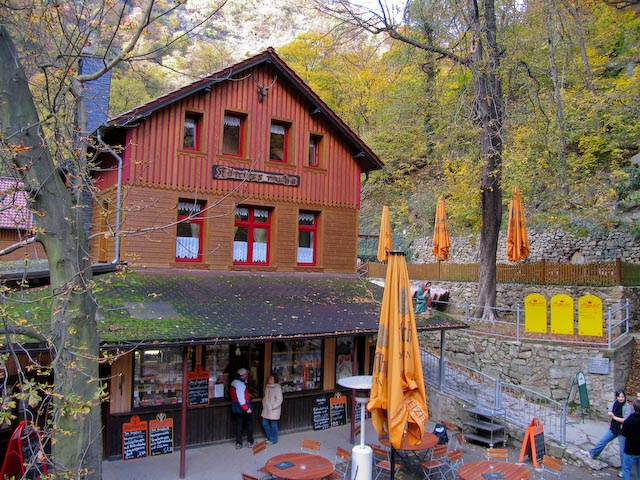
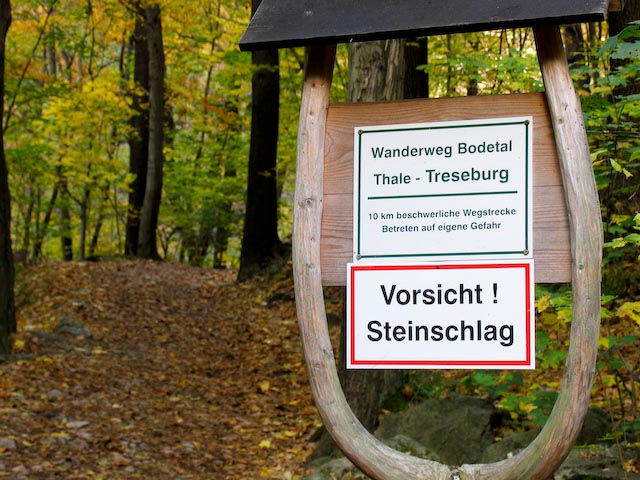
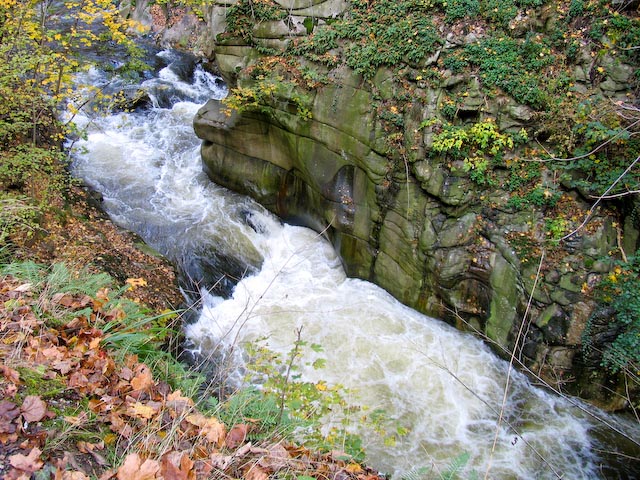
Level with the valley station of the cable car you can look out from the Hubertusbrücke over the Bode as it surges powerfully across large granite blocks. It accompanies us on this section of the walk through one of the finest valley stretches in the Harz. Over the roughly 11 km to Treseburg the going is fairly comfortable, through a magnificent valley landscape that is gorge-like in places and later opens into an almost gentle scene.
Not far from here the granite juts into the Bode valley as a steep crag. This rock was originally called Siebenbrüderfelsen, the rock of the seven brothers. Naturally there is a legend about it too. The story goes that seven wicked brothers attacked a beautiful maiden. She called the mountain spirits for help, and they came to her aid by turning the wicked brothers into seven rocks. Among other things, the rocks resemble the heads of an eagle owl, an elephant, a cat and a devil. To mark the 200th birthday of Johann Wolfgang von Goethe on 28 August 1949 (Goethe stayed in the Bode valley around 1784), the rock was renamed Goethefelsen by the Kulturbund.
The valley grows steadily narrower up to the idyllic “Am Hirschgrund” inn below the Rosstrappe.
We carry on across the Jungferbrücke, where yews and pines grow on the slope above. The undemanding pines thrive even on rocky ridges.
After reaching the Teufelsbrücke (built in 1863) it goes properly uphill for a while. It is still about 8 km to Treseburg.
The granite walls rise steeply. Up to this point the character of the valley is shaped by granite alone. Because granite is so resistant, the Bode was only able to carve a narrow, gorge-like valley. Part of this narrow section is the Bodekessel, visible from this path: a so-called pothole or plunge pool around 5 m across, ground out of the bedrock over thousands of years by the plunging Bode and the rock it carries. Boulders and stones structure the riverbed.
The legendary Bodekessel is the best-known rapid on the Bode (beyond the Teufelsbrücke and not far from the Königsruhe inn). Before it was blasted in 1784 to make the Bode navigable for rafts, it was a low waterfall.
The legend, however, tells it like this…
The Germanic god Wasur (the eternal cycle of water) broke through the rock wall that once joined the Hexentanzplatz and the Rosstrappe. He wanted to save Wotan from the wrath of his father Hodir. In doing so he cleared the way for the Bode and created the Bodekessel. Wotan was then placed on the throne of the gods.
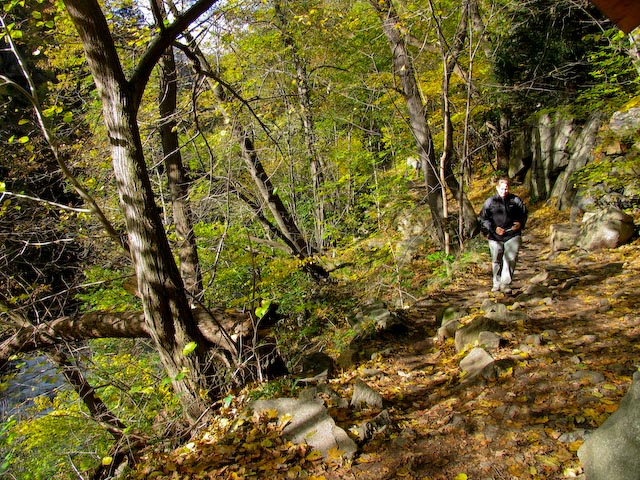
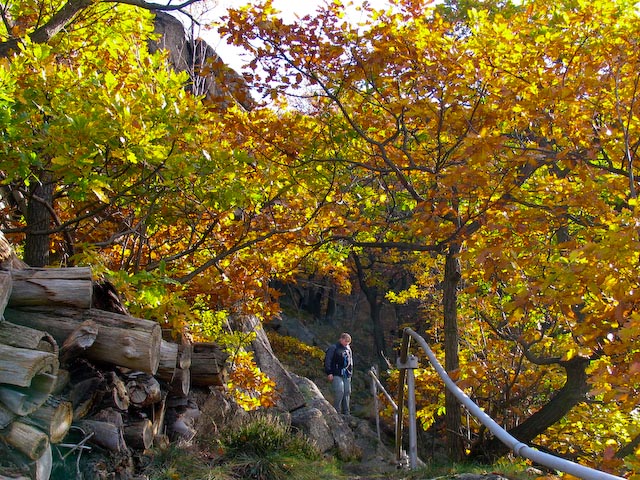
We continue uphill until we reach the upper limit of the granite. Here the slopes are no longer so rugged and the rushing of the Bode is not as loud. The closer we get to Treseburg, the flatter the terrain becomes. The paths are easy going. The deciduous forest (copper beech, large-leaved lime, hornbeam and sycamore) glows in its finest colours and is simply a feast for the eyes.
There is a shelter in the area of the Brummerhals nature reserve. The ideal place for a break, we think.
Here, at the mouth of the Dambach, stands an old stand of beeches with trees up to 20 m tall.
We reach Treseburg easily and briskly in next to no time. The path is straightforward. Just as well, because it lets us save some strength for the climb beyond Treseburg.
It climbs continuously for about 30 minutes. My poor muscles. Up to the high point past individual small crags, through mixed woodland, mainly oak, beech and hornbeam. Shortly before the end of the climb we take a break at the “Weißer Hirsch” viewing platform. From here you have a wonderful view of the Bode valley and beautifully situated Treseburg.
From here the character of the path changes too. It follows a forest road mainly through beech woods. At the “An der Hagedornstraße” shelter we leave the forest road and turn left into the Dambach valley. Once we reach the valley floor we continue to the right.
We pass the Pfeil monument:
Information about it here: http://de.wikipedia.org/wiki/Friedrich_Wilhelm_Leopold_Pfeil
Very close by, a bench invites you to linger, which no longer tempts us since it is only about 1.5 km from here back to our car.
It was a really lovely walk. The only drawback was the number of people. I think a walk like this is nicer on a weekday than at the weekend. Unless you like the bustle, of course…
Wildlife you can see here (if you are lucky)
There are many rare species here, among them wildcat, Bechstein’s bat, peregrine falcon, black stork and middle spotted woodpecker. The insect fauna is very rich in species. Dipper and grey wagtail can often be watched hunting insects along the streambed. Mallards breed in places in the reeds or on remote gravel beds, and in the spring spawning season fire salamanders are out and about in the Bode valley. You have to watch your step when walking.
Besides brown trout, the Bode is naturally home to stone loach, bullhead, three-spined stickleback and minnow. Pike, dace and perch are rare. Rainbow trout were introduced by anglers.
Map – the Bode valley between Treseburg and Thale